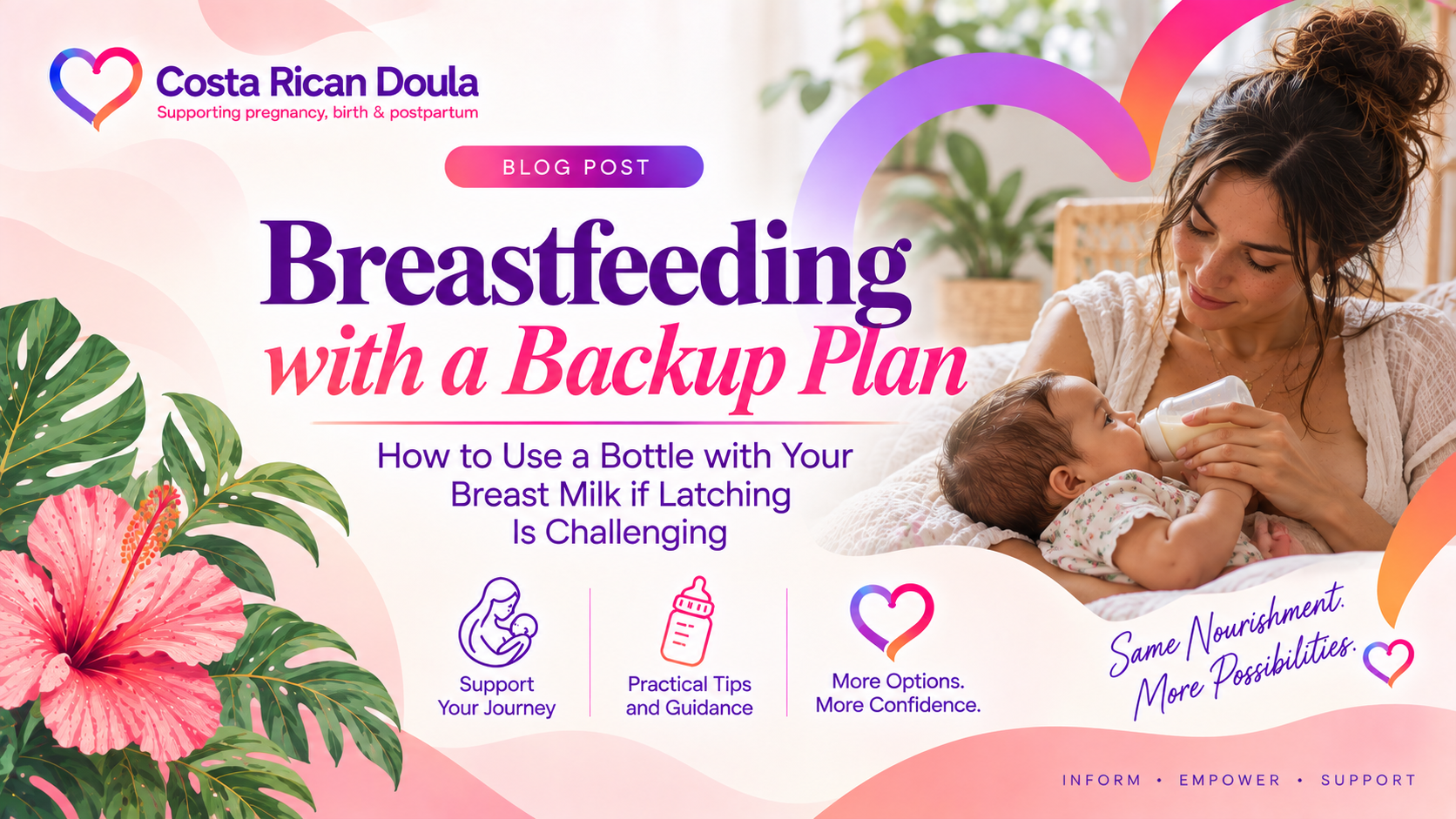
Breastfeeding With a Backup Plan: How to Feed Your Breast Milk by Bottle When Latching Is Challenging
Breastfeeding does not always look like a baby peacefully latching at the breast.
Sometimes a mother has milk, wants to breastfeed, and is committed to continuing, but her baby is struggling to latch. Sometimes nipples are sore, a baby refuses the breast, feeding becomes stressful, or mother and baby need another way to get through a difficult period.
And sometimes, breastfeeding means pumping your milk and giving it to your baby another way.
That does not make your breast milk any less valuable.
As a full spectrum doula, one of the things I want mothers to know is that feeding does not have to be all or nothing. A bottle, syringe, nipple shield, or breast pump can sometimes become part of your breastfeeding journey rather than the end of it.
The World Health Organization recognizes that when a baby cannot breastfeed directly, expressed breast milk may be offered through alternative methods including cups, spoons, syringes and bottles or teats, depending on the baby’s circumstances. When the inability to breastfeed directly is temporary, mothers and babies should be supported in returning to breastfeeding when they are able. World Health Organization
So let’s talk about your backup plan.
What can I do if my baby cannot latch?
First, a difficult latch does not automatically mean that you need to stop breastfeeding.
There are many reasons a baby may struggle at the breast, and the appropriate solution depends on what is happening with you and your baby.
If breastfeeding is painful, your baby repeatedly cannot latch, refuses the breast, seems unusually sleepy during feeds, has fewer wet diapers than expected, or you are concerned about weight gain, reach out to your pediatrician and a qualified lactation professional. Feeding difficulties sometimes need more than a change of technique.
While you are getting support, expressed breast milk can provide another way of feeding your baby.
Depending on your particular situation and professional guidance, options can include:
- Expressed breast milk in a bottle. This may be the most practical solution for many families, particularly when pumping will be part of everyday life.
- A nipple shield or pezonera. For some breastfeeding challenges, a lactation professional may recommend a properly fitted nipple shield. It is best used with guidance because the underlying reason for the latch problem still matters.
- Syringe feeding. Small quantities of milk may sometimes be offered using a syringe. Because technique matters, especially with a newborn, ask your pediatrician, nurse, midwife, or lactation professional to demonstrate it rather than experimenting on your own.
- Finger-assisted feeding. In some situations, a professional may demonstrate a feeding technique involving a clean or gloved finger and a supplemental feeding system. This is different from simply squirting milk into a baby’s mouth and should be taught in person.
- Cup or spoon feeding. These are additional methods recognized by WHO when direct breastfeeding is temporarily not possible. World Health Organization
The goal is not to find the method that looks most like “perfect breastfeeding.” It is to find a safe way to nourish your baby while protecting your breastfeeding goals whenever possible.
Giving Breast Milk in a Bottle Is Still Breastfeeding
This distinction is important.
Breast milk and breastfeeding at the breast are related, but they are not the same thing.
If your baby cannot currently take milk directly from your breast, you can express your milk and offer it another way.
For some families, this happens for a couple of days.
For others, pumping becomes part of their routine for weeks or months.
And some mothers exclusively pump.
Your feeding plan can change as your baby’s needs change.
If you are introducing a bottle
Try to make bottle feeding calm and responsive rather than focusing on making your baby finish a predetermined amount.
Hold your baby securely, watch their hunger and fullness cues, and allow pauses during the feeding. If your goal is eventually returning to the breast, ask your lactation professional whether paced bottle feeding and an appropriate nipple flow would be useful for your particular baby.
Never prop a bottle or leave a baby unattended while feeding.
What Do I Need to Pump Breast Milk?
You do not need an enormous collection of breastfeeding products.
A practical starter kit might include a breast pump, properly fitting flanges, a few bottles, bottle nipples, breast milk storage bags or food-grade storage containers, labels or a permanent marker, a bottle brush or other cleaning supplies, and an insulated cooler with ice packs if you’ll be transporting milk.
A hands-free pumping bra can also make frequent pumping considerably easier.
Manual or electric breast pump?
A manual pump can be useful for occasional pumping, travel, relieving fullness, or keeping as a backup. It is usually portable and does not require electricity.
An electric pump can be more practical if pumping is going to happen frequently or become a significant part of your feeding plan.
The most expensive pump is not automatically the right pump. Comfort, flange fit, frequency of pumping, and your individual response to the pump all matter.
And remember that hand expression is another form of milk expression. The CDC recognizes hand expression as well as manual and electric pumping. CDC
Organizing Your Bottles Without Turning Your Kitchen Into a Milk Laboratory
Once pumping becomes part of your routine, organization can make an enormous difference.
Create one dedicated breast milk station.
Keep clean bottles, nipples, pump components, labels and storage bags together. Have a separate area for items waiting to be washed so clean and used pieces don’t get mixed together.
For refrigerated milk, organize it by date so that the oldest appropriate milk is used first.
For frozen milk, I recommend the same principle:
First in, first out.
The CDC specifically recommends using the oldest stored milk first. CDC
A small basket in your refrigerator labeled USE FIRST can save a surprising amount of mental energy at 3 a.m.
How to Start Your Own Breast Milk Stash
I prefer the phrase breast milk stash or personal milk reserve for milk you express and store at home, since an official human milk bank is something different.
You also don’t need a freezer filled from top to bottom.
Start small.
Step 1: Express your milk safely
Wash your hands before expressing or handling breast milk. If using a pump, inspect your equipment and make sure it is clean. CDC
Step 2: Store milk in appropriate containers
Use containers designed for breast milk or clean, food-grade containers with tight-fitting lids.
Do not use ordinary household plastic bags or disposable bottle liners as breast milk storage bags. CDC
Step 3: Store smaller portions
Freezing smaller amounts can help prevent wasting milk.
The CDC suggests storing approximately 2 to 4 oz (60 to 120 mL), or the amount your baby typically takes during one feeding. Leave some space in the container because milk expands when frozen. CDC
Step 4: Label everything
Write the date of expression on every bag or container. Adding the amount can make your system even easier to manage.
If your baby attends daycare, follow the facility’s labeling requirements as well.
Step 5: Freeze flat
Breast milk storage bags can be laid flat while freezing. Once frozen, they can be organized vertically in a container, almost like little files.
Organize them from oldest to newest.
Step 6: Use the oldest milk first
Think:
FIRST IN → FIRST OUT
That way you continuously rotate your supply instead of discovering milk at the back of the freezer months later.
How Long Can Breast Milk Be Stored?
For healthy, full-term babies, current CDC guidance says freshly expressed milk can generally be kept:
| Location | Freshly Expressed Breast Milk |
|---|---|
| Room temperature, 25°C / 77°F or colder | Up to 4 hours |
| Refrigerator, 4°C / 40°F | Up to 4 days |
| Freezer, -18°C / 0°F or colder | About 6 months is best; up to 12 months is acceptable |
Previously frozen milk that has completely thawed in the refrigerator should be used within 24 hours. Once milk has been warmed or brought to room temperature, use it within 2 hours. Previously frozen milk should not be refrozen after it has completely thawed. CDC
Because Costa Rica can be considerably warmer than 25°C, don’t automatically assume the four-hour room temperature maximum applies everywhere. The CDC specifically notes that warmer environments affect storage time and recommends refrigerating milk sooner when the environment is warm. CDC
That is particularly important here.
Can I add freshly pumped milk to milk already in the refrigerator?
Cool the newly expressed milk first before combining it with milk that is already chilled.
The CDC advises against adding warm, freshly expressed milk directly to previously cooled or frozen milk because it can rewarm the older milk. When cooled milk from different pumping sessions is combined, storage time should be based on the oldest milk in the container. CDC
How Do I Defrost Breast Milk?
Use the oldest milk first.
You can thaw frozen breast milk overnight in the refrigerator, place the sealed container in warm or lukewarm water, or hold it under lukewarm running water.
Do not microwave breast milk.
Microwaving can create hot spots that may burn your baby’s mouth and can affect some of the milk’s nutritional properties. CDC
Breast milk does not actually have to be warm. If your baby accepts it cold or at room temperature, warming is optional.
And if your baby doesn’t finish a bottle, current CDC guidance is to use the leftover milk within 2 hours after the feeding ends, then discard what remains. CDC
What Breastfeeding Supplies Can I Find in Costa Rica?
Fortunately, pumps and milk storage supplies have become easier to find locally.
Baby’s store Costa Rica is one local option in Ciudad Colón worth checking for baby supplies.
TheBabies.CR lactation and pumping supplies currently lists manual pumps, silicone milk collectors, hands free pumping bras, breast milk storage cups and storage bags, including Medela options. The Babies
Walmart Costa Rica lactation products also lists breastfeeding accessories online, including electric pumps and breast milk storage bags. Inventory and prices can change, so check availability before making a trip. Walmart
For example, local online listings currently include Medela breast milk storage bags and other dedicated milk storage bags with labeling areas and leak-resistant closures. The Babies
You do not need to purchase one specific brand. Look for products specifically designed for breast milk storage and follow the manufacturer’s instructions.
When Breastfeeding Doesn’t Go According to Plan
One of the books that has accompanied me in supporting mothers is The Nursing Mother’s Companion by Kathleen Huggins, RN, MS.
What I appreciate about resources like Huggins’ book is the reminder that breastfeeding is not just a technique. It is a relationship that develops between a mother and her baby, and sometimes that relationship requires troubleshooting, patience, and alternatives.
The book discusses situations such as refusal to nurse, fussiness, colic, and reflux, as well as circumstances in which expressed breast milk and bottle feeding can become part of navigating a breastfeeding challenge.
Some medical and infant care recommendations have evolved since different editions of the book were published, so I use books like this as educational companions while relying on current clinical guidance for safety recommendations, particularly for milk storage, infant sleep and feeding concerns.
That distinction matters.
Your Backup Plan Is Still Part of Your Breastfeeding Journey
You might breastfeed directly in the morning.
Pump in the afternoon.
Give a bottle of your breast milk at night.
Use a nipple shield temporarily.
Express milk while working.
Build a small freezer stash.
Return to direct breastfeeding later.
Or discover that exclusive pumping works best for your family.
There isn’t only one way that a breastfeeding journey has to look.
Same nourishment. More possibilities.
What matters is having good information, appropriate professional support, and a feeding plan that keeps your baby nourished while supporting your own physical and emotional well-being.
Want to Build a Breast Milk Stash?
I created a separate step-by-step guide specifically about how to create and organize your own breast milk stash, including safe storage, labeling, freezing, thawing, and rotation practices.
→ [How to Build a Breast Milk Stash: Safe Storage & Organization Guide]
Coming soon
Internal linking between these related articles can also help Google understand the relationship between your breastfeeding content while giving parents a natural next question to explore.
Frequently Asked Questions About Breastfeeding With a Bottle
Can I breastfeed and give my baby pumped milk in a bottle?
Yes. Some families combine direct breastfeeding with expressed breast milk. If you are introducing bottles while trying to establish or maintain breastfeeding, a lactation professional can help you develop a plan based on your baby’s age, latch and milk transfer.
Does giving breast milk in a bottle mean I stopped breastfeeding?
No. Expressing breast milk can be part of a breastfeeding or lactation journey. Whether you feed directly at the breast, combine breast and bottle feeding, or exclusively pump will depend on your circumstances and goals.
What should I do if my newborn suddenly refuses the breast?
A sudden or persistent feeding change deserves attention. Rather than assuming your baby simply prefers a bottle, consider contacting your pediatrician and a qualified lactation professional, particularly if feeding is accompanied by pain, poor weight gain, unusual sleepiness, fewer wet diapers, vomiting, breathing difficulties or signs of illness.
Can I use a syringe instead of a bottle?
Syringes are among the alternative feeding methods recognized for babies who cannot temporarily feed directly at the breast. The appropriate method depends on the baby’s age and clinical circumstances, so syringe feeding should be demonstrated by a trained professional. World Health Organization
Do I need a huge freezer supply before returning to work?
Usually, the goal doesn’t need to be filling an entire freezer. A manageable reserve plus a sustainable pumping routine may be much more useful. Your individual needs depend on your baby’s feeding pattern, work schedule, and access to pumping and refrigeration.
Can I travel around Costa Rica with pumped breast milk?
Yes. According to CDC guidance, expressed milk can be transported in an insulated cooler with ice packs for up to 24 hours. At your destination, use it, refrigerate it, or freeze it as appropriate. CDC
A note from Costa Rican Doula
Breastfeeding challenges can feel enormous when you’re exhausted and trying to understand what your baby needs.
You don’t have to have every answer on day one.
Sometimes the most useful thing we can create is a Plan B that still supports Plan A.
Whether that means direct breastfeeding, pumping, expressed breast milk in a bottle, or a temporary alternative feeding method, the objective is not perfection. It is helping you and your baby find a feeding rhythm that is safe, sustainable and supported.
Inform. Empower. Support.
This article is educational and is not a substitute for individualized medical or lactation care. Feeding difficulties, concerns about milk supply, dehydration, poor weight gain, persistent pain or symptoms of illness should be discussed with your baby’s pediatrician and an appropriately qualified lactation professional.