By María José | Costa Rican Doula
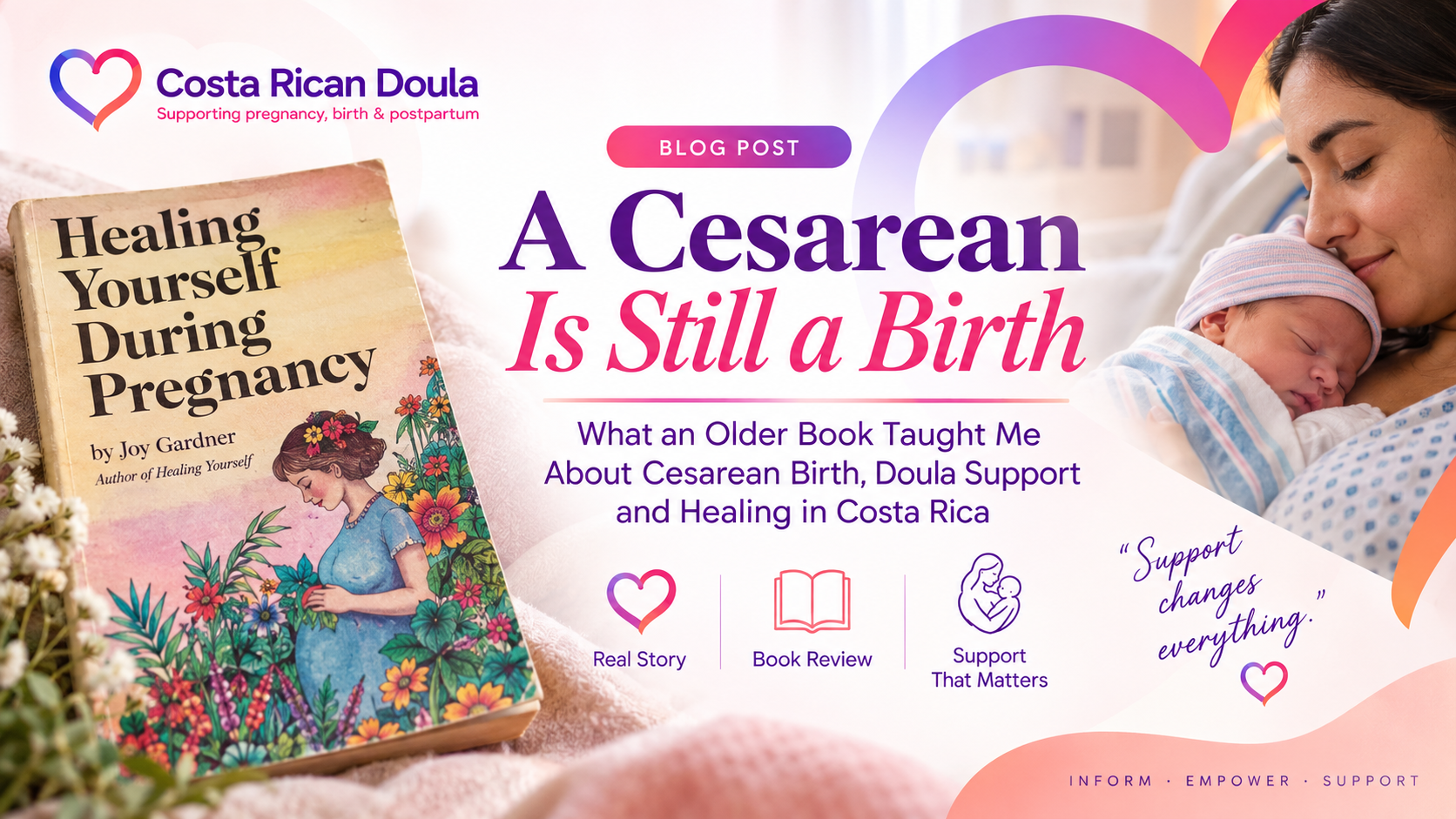
Book reflection: Healing Yourself During Pregnancy by Joy Gardner
Some books find us at exactly the right moment.
When I began reading Healing Yourself During Pregnancy by Joy Gardner, I expected a book about pregnancy. Instead, I found myself thinking deeply about birth, cesarean sections, emotional recovery, informed choices, and what it truly means to support a mother during one of the most vulnerable moments of her life.
The book is from another era, and some of its medical recommendations reflect the knowledge and birth practices of the time in which it was written. They should not be treated as current medical guidance. But beneath those dated recommendations, I found something that still feels remarkably relevant today:
A mother’s emotional experience of birth matters.
And while reading the chapters about cesarean birth, I kept thinking about one particular experience I had as a doula in Costa Rica.
I thought about Elizabeth.
I thought about her baby girl.
And I thought about the hours we spent together at Hospital CIMA in San José, before, during, and after her cesarean birth.
That experience reminded me why doula support can matter just as much during a C-section as during a vaginal birth.
A Book That Looks at Pregnancy as More Than a Physical Experience
Healing Yourself During Pregnancy approaches pregnancy from a holistic perspective. Joy Gardner writes about the connection between the body, emotions, intuition, relationships, birth, and recovery.
Reading it today requires some perspective.
This is not a modern obstetric textbook, and I would not recommend using its decades-old statistics or specific clinical recommendations to make medical decisions today. Current decisions about cesarean birth, VBAC, anesthesia, induction, postpartum recovery, and birth location should always be discussed with qualified healthcare professionals using current evidence and the individual circumstances of each pregnancy.
But I don’t think that makes this book irrelevant.
In fact, I found its emotional message surprisingly timeless.
One of the themes that stayed with me is the importance of allowing a mother to feel what she feels about her birth.
Birth can bring joy and relief alongside fear, disappointment, vulnerability, exhaustion, grief, empowerment, or gratitude. Sometimes many of those emotions exist simultaneously.
The book encourages women not to dismiss those feelings simply because the baby is healthy.
That matters.
A positive birth experience is about more than a clinical outcome. The World Health Organization’s current approach to maternity care also emphasizes dignity, informed choice, effective communication, psychological safety, and continuous support as important parts of a positive childbirth experience.
And that is where this book connected so strongly with my work as a doula.
A Cesarean Is Still a Birth
There is a section of the book titled “If You Must Have a Cesarean.”
Reading those pages made me stop.
The language reflects the era in which the book was written, and today I would frame the conversation differently. A cesarean section can be medically necessary, planned, unexpected, wanted, unwanted, lifesaving, empowering, difficult, beautiful, or some combination of these.
The World Health Organization recognizes that cesarean sections can prevent maternal and newborn mortality when medically indicated, while also acknowledging that, like any major surgery, they carry short- and long-term considerations.
But what struck me most about Gardner’s discussion wasn’t the medical advice.
It was her attention to the mother’s experience.
She writes about keeping the mother connected to her baby, minimizing unnecessary separation, receiving support from her partner or birth companion, and permitting herself afterward to process what happened.
That immediately brought me back to Elizabeth’s birth.
Supporting Elizabeth Through Her C-Section at Hospital CIMA
Elizabeth had her baby girl by cesarean section at Hospital CIMA.
I was her doula.
And my role didn’t suddenly become less important because her baby was being born in an operating room.
In many ways, the need for support simply changed.
Hospital CIMA describes its maternity program as providing medical and human support through pregnancy, childbirth, and postpartum care, including both vaginal births and cesarean sections. Its current Baby CIMA program also emphasizes informed decisions, respect for birth preferences, and humanized maternity care.
But even in an excellent medical environment, there are things a doula can provide that are fundamentally different from clinical care.
Presence. Continuity. Reassurance. Familiarity.
I was there with Elizabeth before the cesarean, during the birth, after her baby girl arrived, and throughout that first night in the hospital.
After surgery, the experience changes quickly.
There is a newborn who needs care.
There is also a mother who has just undergone major abdominal surgery.
She may be excited and overwhelmed at the same time. She may be uncomfortable, exhausted, emotional, medicated, unable to move easily, and adjusting to the enormous realization that her baby is finally here.
Sometimes the most meaningful thing you can offer isn’t another piece of information.
It is simply:
“I’m here. You don’t have to navigate these first hours alone.”
What Elizabeth Taught Me About Doula Support After a Cesarean
Afterward, Elizabeth shared something with me that I will always treasure.
She described my presence as calm and reassuring and said it made an enormous difference during those first hours after surgery, when she was exhausted and beginning her recovery.
She wrote:
“I can genuinely say that I don’t know how I would have managed the experience without her. Having María José by my side gave me an incredible sense of comfort, security and support during those first hours of recovery.”
What touched me most about her words wasn’t simply that she appreciated having a doula.
It was why.
She talked about practical help and emotional support.
She talked about someone caring for both her and her baby.
She talked about feeling safe.
And she talked about being supported during the hours when she was physically recovering and couldn’t simply jump up every time her newborn needed something.
That is something I wish more expectant mothers understood about doula support for a planned C-section in Costa Rica.
A doula isn’t only for labor.
What Does a Doula Do During a C-Section?
This is one of the questions I hear frequently, and it deserves a clear answer.
A doula provides non-medical emotional, informational, and practical support before, during, and after birth, including cesarean birth, within the hospital’s policies and the mother’s medical care plan.
Before surgery, that can mean helping a mother feel prepared, talking through what she may experience, helping her organize her preferences and questions for her medical team, and simply being a familiar person in an unfamiliar environment.
Around the birth, it can mean providing reassurance and helping the mother remain connected to the experience rather than feeling as though birth is merely happening to her. What is possible inside an operating room depends on the hospital, physician, anesthesiology team, and clinical circumstances.
And afterward, the role changes again.
Postpartum doula support after a C-section can be incredibly valuable.
A mother is recovering from surgery while simultaneously becoming responsible for a newborn. She may need help positioning herself comfortably, getting things she cannot easily reach, communicating what she needs, settling the baby, creating an environment conducive to rest, or simply having someone nearby while she processes everything that has happened.
A doula does not replace the obstetrician, anesthesiologist, pediatrician, nurse, or lactation professional.
We complement the medical team by focusing continuously on the mother and family’s non-medical support needs.
The Part of Healing Yourself During Pregnancy That Stayed With Me Most
Toward the end of the section photographed from the book, Gardner turns away from procedures and toward feelings.
She encourages mothers to give themselves permission to experience their emotions after birth, particularly when the birth was different from what they had imagined.
That message deserves to survive long after some of the book’s medical advice has become outdated.
Because a healthy baby and a mother’s complicated feelings about birth can coexist.
You can be profoundly grateful for your baby and still need to process your birth.
You can know that a cesarean was necessary and still feel disappointed that your original birth plan changed.
You can have a beautiful cesarean experience.
You can have a difficult one.
You can feel powerful.
You can feel vulnerable.
You can feel all of those things.
There is no requirement that motherhood begin with one particular emotion.
And healing does not have to mean pretending everything was perfect.
What This Book Gets Right, and What Has Changed
As a book review, I would describe Healing Yourself During Pregnancy as thought-provoking, compassionate, holistic, and very clearly a product of its time.
I love the way Gardner invites women to listen to their bodies and emotions and to participate actively in their pregnancy and birth experiences.
I love the emphasis on communication.
I love the recognition that birth doesn’t end the moment the baby arrives.
And I especially appreciate the acknowledgment that women may need time and support to emotionally process their birth experiences.
At the same time, readers should approach the clinical sections carefully. The pages I read contain statistics, terminology, and recommendations about VBAC, uterine rupture, cesarean prevention, anesthesia, IV use, home birth, and hospital timing that come from sources primarily from the 1970s and 1980s.
Those passages should be understood historically, not used as current medical instructions.
Modern evidence-based maternity care has evolved significantly.
What has not become outdated is the underlying idea that women deserve information, dignity, compassion, involvement in decision-making, and continuous human support during childbirth. Those principles align closely with contemporary WHO recommendations for respectful maternity care.
Birth Doesn’t Have to Follow the Plan to Become a Beautiful Story
Perhaps that is what Elizabeth’s birth reinforced for me more than anything else.
We talk so much about birth plans.
Vaginal birth.
Cesarean birth.
Unmedicated birth.
Epidural.
Hospital birth.
And preparation absolutely matters.
But sometimes birth changes the plan.
Support helps us navigate what happens next.
Elizabeth’s daughter arrived by cesarean at Hospital CIMA.
There was an operating room.
There was surgery.
There was recovery.
But there was also tenderness.
There was reassurance.
There was a mother meeting her baby girl.
There was someone beside her through the transition.
There was care through the night.
And there was a birth story that Elizabeth later described as positive and special.
That’s what I want mothers in Costa Rica to know:
A C-section does not make your birth less meaningful.
Needing help does not make you less capable.
And doula care does not have to end when labor ends or when a cesarean begins.
Sometimes the hours after birth are precisely when having continuous support matters most.
Frequently Asked Questions About Doulas and Cesarean Birth in Costa Rica
Can I have a doula if I am planning a C-section in Costa Rica?
Yes, you can arrange doula support for a planned cesarean. However, who may enter the operating room and at what point a doula can be present depends on the hospital, medical team, and circumstances of the birth. Ask your hospital and obstetrician about their current policies before delivery.
What can a doula do after a C-section?
A doula can provide non-medical emotional and practical support during early recovery, help create a calm environment, assist with comfort and positioning within the medical team’s instructions, support communication, help with the baby, and provide reassurance while the mother rests and recovers.
Does Hospital CIMA offer cesarean maternity care?
Yes. Hospital CIMA currently lists both vaginal birth and cesarean delivery among its maternity services and describes its maternity approach as emphasizing safety, comfort, humanized care, and support for mother and baby.
Does a doula replace my doctor or nurse?
No. A doula is not a replacement for medical care. Your obstetrician, nurses, anesthesiology team, pediatric professionals, and other clinicians remain responsible for medical assessment and treatment. A doula’s role is complementary and centers on continuous non-medical support.
Is a doula useful even when I already know I will have a cesarean?
For some families, absolutely. A planned C-section may reduce uncertainty about how the baby will be born, but mothers still experience the emotional transition into motherhood and the physical recovery from surgery. Continuous support can therefore remain meaningful before and after birth.
My Reflection as a Doula in Costa Rica
When I closed these pages of Healing Yourself During Pregnancy, I didn’t come away thinking that we should recreate childbirth as it was understood decades ago.
I came away thinking about how far maternity care has evolved while recognizing something beautifully simple that hasn’t changed:
Women need to feel cared for.
They need information.
They need to know their voices matter.
They need room for their emotions.
And sometimes they need someone whose entire purpose in that moment is simply to stay beside them.
Elizabeth ended her review by saying:
“I will always be extremely grateful to her for being such an important part of my baby’s arrival and for helping to make the experience so positive and special.”
I am deeply grateful that she trusted me with that space.
Every birth teaches me something.
Every mother teaches me something.
And sometimes an old book sitting in my hands connects those experiences in a way I didn’t expect.
That is what Healing Yourself During Pregnancy did for me.
It reminded me that birth is not only about how a baby enters the world.
It is also about how a mother is held, heard, respected, supported, and cared for while she becomes one.
Pingback: Hipnoparto en Costa Rica: cómo prepararte para vivirlo con más calma - costaricandoula.org